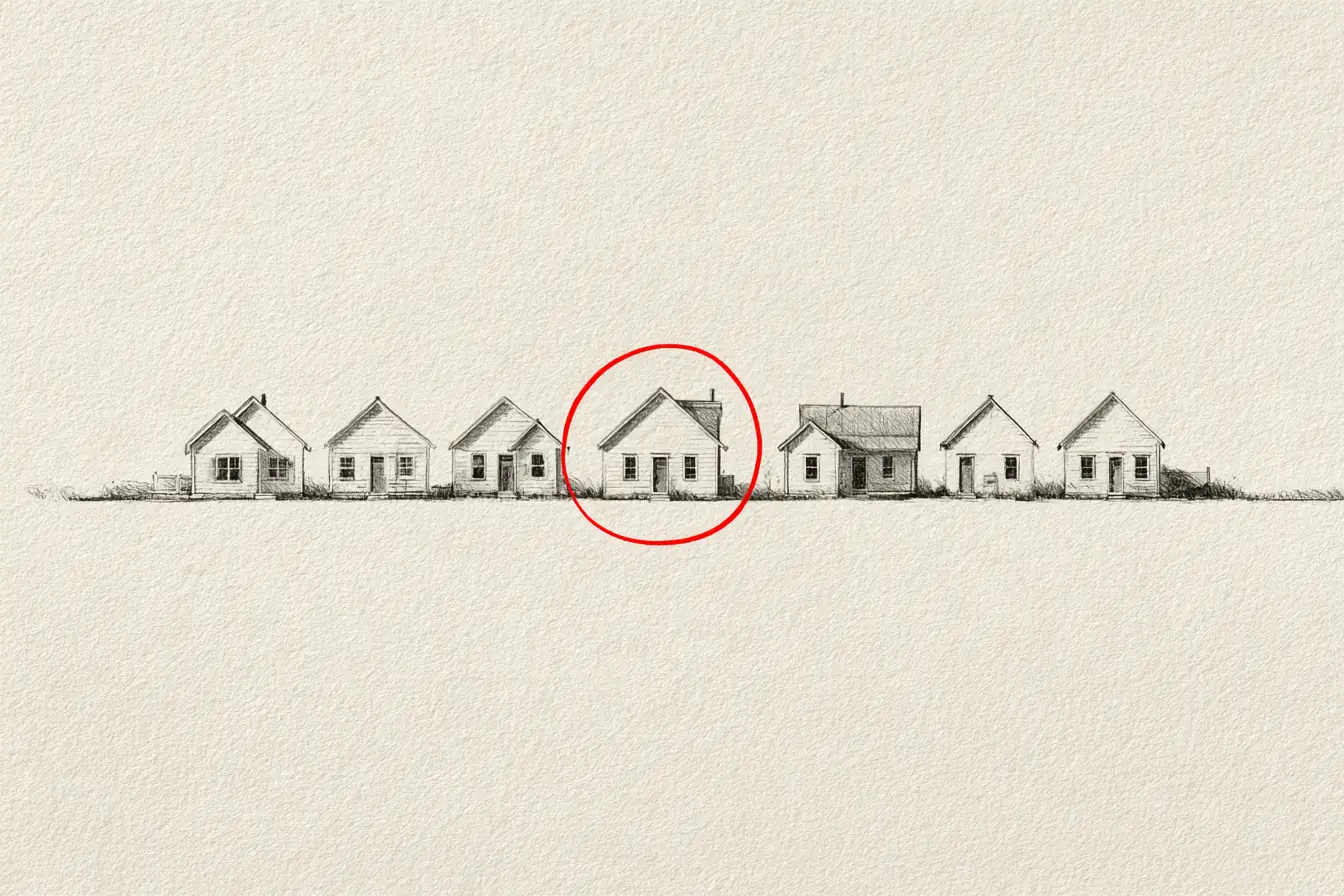
Picture two houses side by side on a quiet street. Same age, same size, the same deadbolts, the same camera by the front door. One day, someone walks that street looking for a house to break into. That person picks one of the two & walks past the other.
The locks did not decide it; they were identical. Burglars weigh several things, the likely payoff & how hard the job looks among them, but two questions keep coming up when researchers interview them: is anyone home, & would anyone see me? Both can be read first from the curb, meaning everything a person standing on the street can see of your home.
What the Burglar Weighs
In one English study, a researcher walked a street with a convicted burglar. Two houses looked almost the same to an untrained eye. The burglar named one as ideal on the spot & said of the other that he "wouldn't touch it." The deciding question was whether anyone seemed to be home. Offenders in the same research estimated that judging a house takes them a matter of seconds; some called it instant.
Interviews with burglars in the U.S. point the same way: most say they would rather pick a house they believe is empty. Being seen matters too. In a 2021 experiment in the Netherlands, 181 imprisoned burglars toured a virtual neighborhood. The simple presence of a person nearby was enough to put them off. Whether that person then did anything more made almost no difference.
I learned the same lesson from the other side. When I led protective details at the cabinet level, our best days left no record at all. Nothing happened, because anyone weighing an attempt could see that someone was there & paying attention. A camera can show you what happened. Our job was making sure nobody tried.
None of this makes locks & lights a waste. In victimization data for England & Wales from 2008 to 2012, outside lights & sturdy door locks were the two most protective single devices, & locks combined with outside lights were tied to a far lower risk of a break-in where someone got inside. The researchers point to earlier research with burglars that found being overlooked is a main deterrent. U.S. residential burglary has fallen by more than 80 percent over four decades, & a 2022 review gives better home security a central role in that drop. Your devices & your habits work on the same two questions.
What You Can Do at Your House
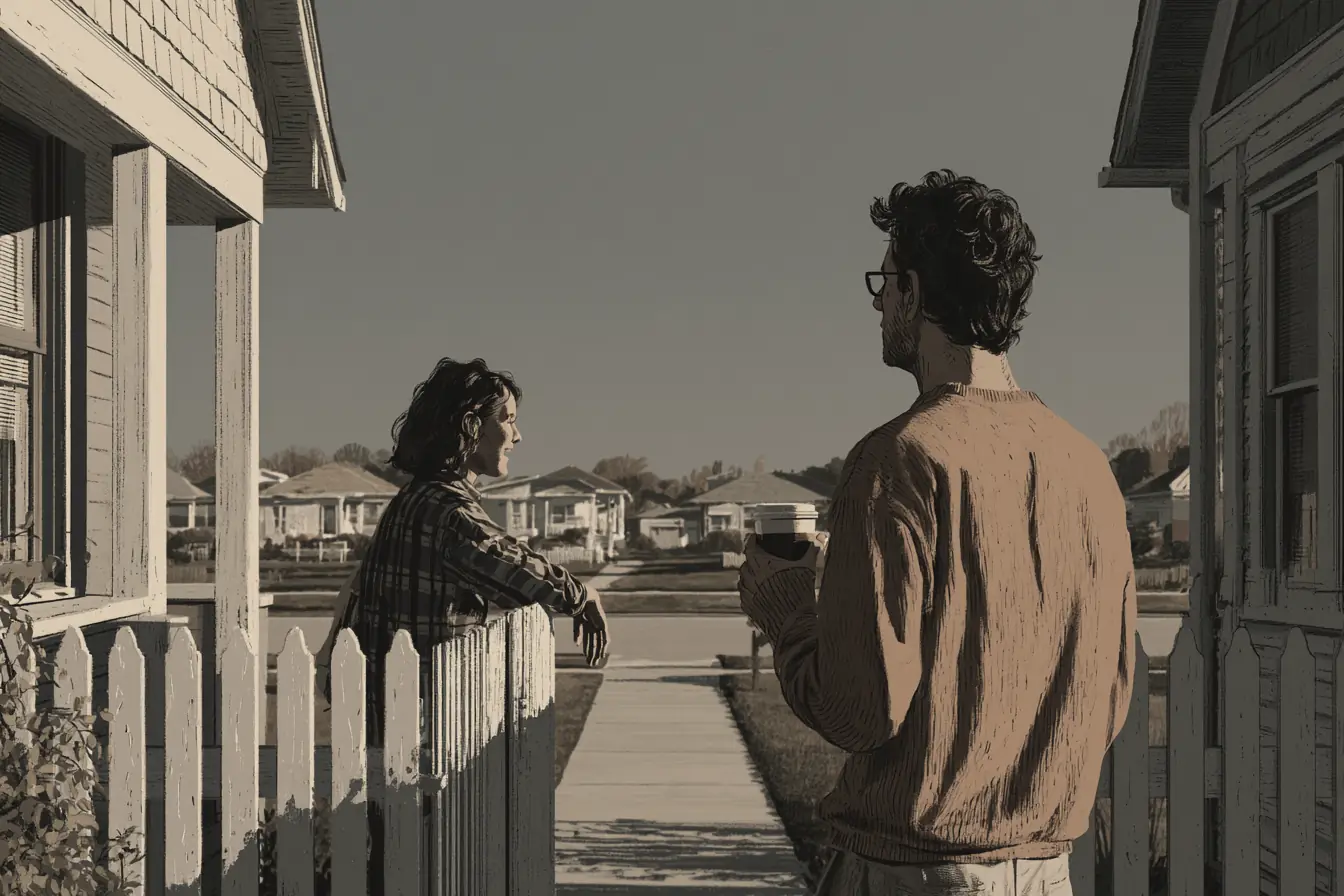
Get to know the people next door. Introduce yourself to the neighbors on either side & across the street, & swap phone numbers. When you will be away, ask one you trust to look in on your place, & do the same for them. In my protective work, the people who noticed something wrong at a place were usually the ones who were there often & knew it well. At home, that is a neighbor who knows you & your house. This is about being known, not about watching anyone: nobody needs to film the sidewalk or keep track of who walks by. If you ever see a break-in actually happening, call 911 & keep your distance.
A neighbor arrangement looks after two houses, not one.
Tell fewer people when the house will be empty. Your travel dates belong to the neighbor who is looking in & to whoever truly needs them for work or family. Everyone else can hear about the trip when you are back.
Keep the front of your home lit & in plain view. Outside lights on a timer or a motion sensor were among the strongest single devices in the England & Wales data. If you rent, ask your landlord about outside lighting, or use plug-in or solar fixtures where your lease allows. A front door your neighbors can see from their own windows is part of your protection, not a lack of privacy.
Lock up, & pair your locks with light. Use the deadbolt you already have, every time you leave. In the same data, locks on doors & windows together with outside lights did far better than any one alone.
Now go back to the two houses. The one that person walked past had the same locks & the same camera. It also had a neighbor out front, & a front door the whole street could see. From the sidewalk, it looked lived in & looked at. That is the part of home security you control.
Where This Stops
Does passing over your house just send the burglar next door? Sometimes, but not as a rule. A 2009 review of 102 situational crime-prevention studies found displacement in about a quarter of the results it examined, & about as often the protection spread beyond the place it was meant for. It measured neighborhoods & many kinds of crime, not house by house. A neighbor arrangement looks after two houses, not one.
One exception matters. Everything here is about a stranger choosing between houses. If the person you worry about already knows you, a former partner, a stalker, or a relative, this advice is not your plan. In federal survey data from 2003 to 2007, when someone was home & a burglary turned violent, the offender was more often someone the household knew than a stranger. Reach out to a domestic-violence or stalking advocate, such as the National Domestic Violence Hotline at 1-800-799-7233, & to local law enforcement.
This is general information, every home is different, & nothing done at the curb guarantees a house will not be chosen. A family that was burglarized did not choose wrong; the person who chose their house did. Questions about what you may lawfully do if someone gets inside belong with a local attorney.
Start at the Curb
This week, knock on one neighbor's door, introduce yourself, & swap numbers. It costs nothing, & it speaks to both questions at once: someone is around, & someone would notice.
If you want a second set of eyes on your own home, Scopos offers a free residential risk assessment, the IRRASM, & I review every one personally.
Who on your street would notice if something were wrong at your house, & when did you last talk with them?
Sources
- Taylor, Emmeline. "PAUSED for Thought? Using Verbal Protocol Analysis to Understand the Situational and Temporal Cues in the Decision-Making of Residential Burglars." Security Journal 31(1), 2018. doi.org/10.1057/s41284-017-0104-3. Supports the street walk in which a convicted burglar chose one of two near-identical houses and rejected the other on whether anyone seemed to be home, and the offenders' estimate that judging a house takes "a matter of seconds." The paper's new data is a pilot think-aloud site visit with two convicted burglars in one English city; the broader study's 30 interviews were published separately. Self-report and a two-person pilot, not a timed or representative measure.
- Cromwell, Paul F., James N. Olson, and D'Aunn W. Avary. "Residential Burglary: An Ethnographic Analysis." National Institute of Justice, 1990, NCJ 126684 (published as "Breaking and Entering," Sage, 1991). ojp.gov, NIJ report record. Supports perceived occupancy, alongside difficulty and gain, as a lever in target choice. Thirty active burglars in one Texas metro area, late 1980s, self-report.
- Wright, Richard T., and Scott H. Decker. "Burglars on the Job: Streetlife and Residential Break-ins." Northeastern University Press, 1994. books.google.com, Burglars on the Job. A foundational interview study of 105 active burglars in St. Louis, including how they choose targets. Cited as part of the U.S. interview literature, not for a specific figure.
- van Sintemaartensdijk, Iris, Jean-Louis van Gelder, Jan-Willem van Prooijen, Claire Nee, Marco Otte, and Paul van Lange. "Mere Presence of Informal Guardians Deters Burglars: A Virtual Reality Study." Journal of Experimental Criminology 17(4), 2021 (online 2020). doi.org/10.1007/s11292-020-09430-1. Supports guardianship as presence: a person simply being nearby deterred 181 incarcerated burglars, and more active guardianship added little. A virtual-reality setting with a Dutch sample.
- Tseloni, Andromachi, Rebecca Thompson, Louise Grove, Nick Tilley, and Graham Farrell. "The Effectiveness of Burglary Security Devices." Security Journal 30(2), 2017. doi.org/10.1057/sj.2014.30. An analysis of the Crime Survey for England and Wales, 2008 to 2012: external lights on a timer or sensor and door double locks or deadlocks were the most protective single devices, and combinations of locks with external lights conferred at least 20 times greater protection against burglary with entry than no security. The authors tie the protection of external lights to visibility, citing earlier offender research. Observational data that cannot separate a house not chosen from an attempt that failed.
- Farrell, Graham. "Forty Years of Declining Burglary in the United States: Explanation and Evidence Relating to the Security Hypothesis." Security Journal 35(2), 2022 (online 2021). doi.org/10.1057/s41284-021-00284-4. Supports the fall of more than 80 percent in U.S. residential burglary across four decades and the central role it credits to improved household security. A narrative review of fifty years of studies, not a causal estimate.
- Guerette, Rob T., and Kate J. Bowers. "Assessing the Extent of Crime Displacement and Diffusion of Benefits: A Review of Situational Crime Prevention Evaluations." Criminology 47(4), 2009. doi.org/10.1111/j.1745-9125.2009.00177.x. Across 102 evaluations and 574 observations, displacement was found in 26 percent and diffusion of benefits in 27 percent; in the 13 studies where it could be weighed against the crime prevented, spatial displacement tended to be smaller. Covers many crime types and is measured at area level, not house by house.
- Catalano, Shannan M. "Victimization During Household Burglary." NCJ 227379, Bureau of Justice Statistics, September 2010. bjs.ojp.gov, Victimization During Household Burglary (PDF). Supports the finding that in burglaries where someone was home and violence occurred, offenders were known to the victims in 65 percent and strangers in 28 percent. Survey data from 2003 to 2007, from a federal report dedicated to occupied burglaries.
This article was produced with AI assistance. The perspective and security expertise are the author's own.